Telemedicine Market Size

The Global telemedicine market size is currently the largest it’s ever been, and shows no signs of slowing down. The latest data from 2025 estimates it to be between $113 billion and $131 billion, depending on which study you reference and their definition of “telemedicine.” Here, we’ve collected the key figures surrounding the current market size and its projected growth and broken down why market estimates vary so widely. We’ve also included an analysis of what sustained, double-digit growth could mean for health organizations, and how it could affect how they evaluate telemedicine software, devices, interoperability, and remote care infrastructure.
Telemedicine Market Size at a Glance
| Metric | Value | Year | Source |
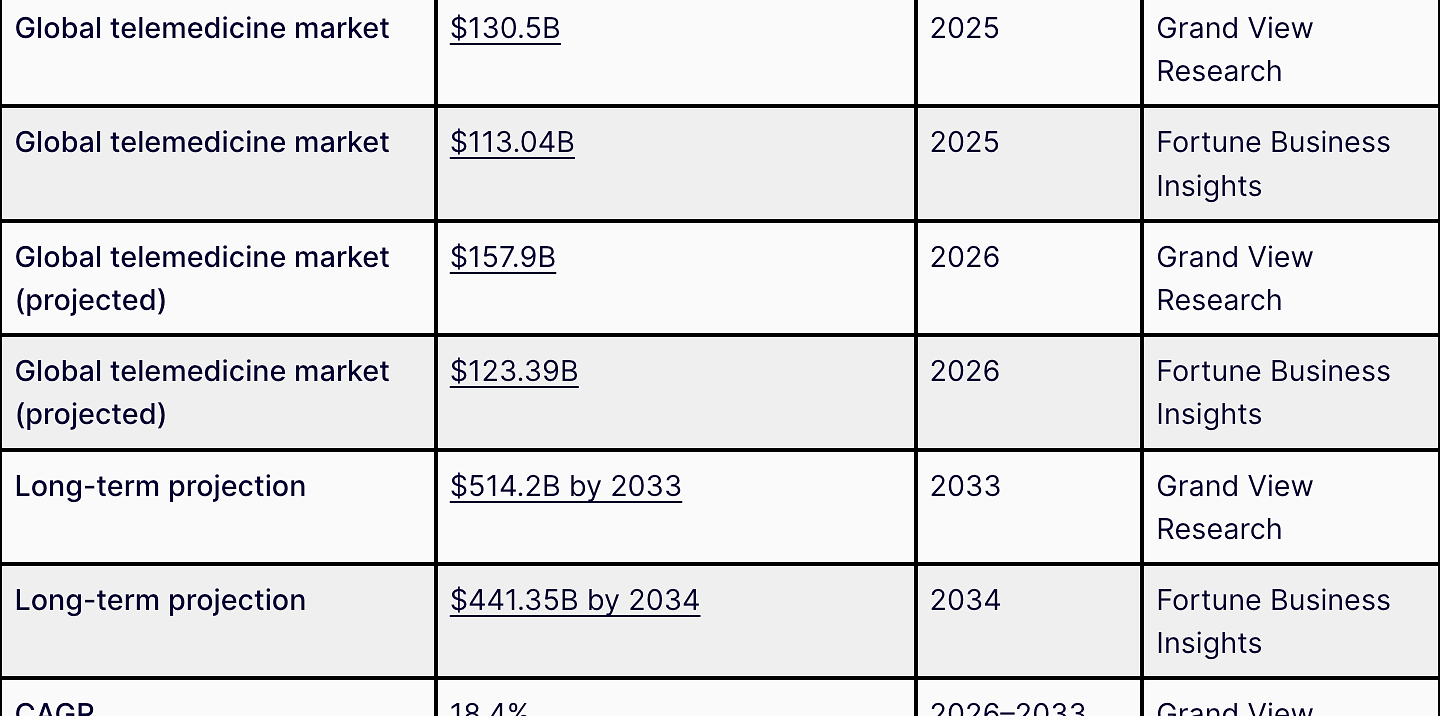
| Global telemedicine market | $130.5B | 2025 | Grand View Research |
| Global telemedicine market | $113.04B | 2025 | Fortune Business Insights |
| Global telemedicine market (projected) | $157.9B | 2026 | Grand View Research |
| Global telemedicine market (projected) | $123.39B | 2026 | Fortune Business Insights |
| Long-term projection | $514.2B by 2033 | 2033 | Grand View Research |
| Long-term projection | $441.35B by 2034 | 2034 | Fortune Business Insights |
| CAGR | 18.4% | 2026–2033 | Grand View Research |
| CAGR | 17.27% | 2026–2034 | Fortune Business Insights |
| U.S. market estimate | $54.26B | 2026 | Fortune Business Insights |
| North America market share | 34.4% | 2025 | Grand View Research |
| Fastest-growing region | Asia Pacific | 2026 | Grand View Research |
| Fastest-growing segment | Software/platforms, 17.79% CAGR | 2026–2034 | Fortune Business Insights |
| Hardware/products share | 51.2% of global market | 2025 | Grand View Research |
| U.S. hospitals with telemedicine installed | 78.6% | 2025 | Towards Healthcare |
Why There’s So Much Fluctuation in the Industry Telemedicine Market Estimates
| Variable | Low-End Effect | High-End Effect |
| Scope definition | "Telehealth" is defined as software and services only | "Telemedicine" is defined to include hardware, connected devices, and RPM |
| Remote Patient Monitoring inclusion | Excluded from the telemedicine estimate | Counted as part of the telemedicine market |
| Geography | U.S.-only estimates | Global estimates, including Asia Pacific and Latin America |
| Forecast period | 2033 endpoint | 2035 endpoint |
| Methodology | Conservative revenue-based modeling | Broader total addressable market modeling |
Before digging into how large the telemedicine market is and where it’s trending, it’s important to understand why there’s so much variation between estimates. For the most part, the fluctuation comes from how differently each research firm defined telemedicine, including what they considered within the scope of that definition. The other factors that led to this variability were the regions included in the study, the forecast period, and the modeling methodology.
For example, Grand View Research published both a telehealth report and a telemedicine report for 2025, but the former sized the market at $77.4 billion while the latter sized it at $130.5 billion. Telemedicine included hardware and connected devices as 51.2% of total market revenue, while the telehealth report skewed more towards services and software instead.
This is crucial for buyers to keep in mind when reviewing the data. For example, a device manufacturer or integrated-device platform should reference the broader hardware-inclusive figure rather than the one skewed towards software and services. Before making investment or budget decisions, buyers should clarify internally what their definition of telemedicine is and what segments they put the most weight on, and reference the corresponding research figures.
How Large Is the Telemedicine Market Size, and Where Is It Heading?
| Scope | 2025 Market | 2026 Estimate | Long-Term Projection | CAGR |
| Telemedicine, including hardware and devices | $130.5B | $157.9B | $514.2B by 2033 | 18.4% (2026 to 2033) |
| Telemedicine, emphasis on services and software | $113.04B | $123.39B | $441.35B by 2034 | 17.27% (2026 to 2034) |
| Telemedicine, emphasis on services and clinical application delivery | $86.59B | $103.89B | $446.11B by 2034 | 19.98% (2026 to 2034) |
No matter which estimate you’re looking at, the telemedicine market is predicted to more than triple its current size by the early 2030s. The two biggest drivers for this trend are reimbursement formalization and the explosion of chronic diseases paired with widespread specialist shortages.
Reimbursement and Policy Expansion: Before 2019, Medicare covered some telehealth services, but access was limited by rural and originating-site restrictions. Then, in 2019, CMS added payment for virtual check-ins, remote physiologic monitoring, and interprofessional internet consultations. However, the major expansion to this policy came on March 6, 2020, when COVID-19 public health emergency waivers allowed Medicare to cover telehealth for patients at home and across all geographic areas. Since then, CMS has continued adjusting covered services and billing policies, including rules affecting Rural Health Clinics and Federally Qualified Health Centers, like the CY 2025 Physician Fee Schedule final rule that continued certain key telecommunication billing policies for Rural Health Clinics (RHCs) and Federally Qualified Health Centers (FQHCs) through 2025. These updates have created a more supportive environment for health systems building virtual care programs.
Chronic disease prevalence and the specialist shortage crisis: Along with a rapidly aging population, the growing share of patients dealing with hypertension, diabetes, COPD, and cardiovascular disease has put significant strain on an already overtaxed healthcare system. On top of this, rural and underserved areas don’t have access to the same number of physicians and health facilities nearby. Telemedicine, however, could connect specialists to these areas and increase the number of patients providers can see per day.
Telemedicine Market by Segment
| Segment | Market Position | Key Data Point |
| Hardware and connected devices | 51.2% of telemedicine revenue | Largest single segment in hardware-inclusive measures |
| Clinical services | Largest by share in service-inclusive measures | Covers virtual consultations, RPM clinical services, and care management |
| Software and platforms | Fastest-growing segment, 17.79% CAGR | EHR-integrated platforms and cloud-based telemedicine software |
| Real-time (synchronous) | 38.2% of market by modality | Largest modality; includes live video and specialist consultations |
| Web and mobile delivery | 79.0% of telemedicine access | Browser and app-based access without dedicated hardware |
| Healthcare providers | 53.2% of market by end-user | Hospitals, clinics, and specialty practices |
Takeaways:
- Hardware and connected devices make up 51.2% of GVR's telemedicine market size because clinical remote medical consultations require equipment that can capture and send diagnostic evidence and imaging.
- The Software and platforms segment is the fastest-growing slice of the pie at 17.79% CAGR because it is the infrastructure connecting the hardware to patient records and medical specialists. In tandem, these two statistics describe a telemedicine market that’s shifting away from video-only telemedicine and moving toward unified clinical programs.
What this means for technology buyers: Choosing which software and hardware to purchase is a connected decision. To avoid future issues with interoperability as well as unnecessary extra work and higher costs, buyers should evaluate software and hardware purchases at the same time and ensure that the products purchased work together.
Regional Telemedicine Market Breakdown
Fortune Business Insights projects the global telemedicine market to reach $123.39 billion in 2026, with North America remaining the largest regional market and Asia Pacific expected to grow the fastest.
| Region | Position in the telemedicine market | Reported outlook | Main growth factors |
| North America | Largest regional market | Maintains market leadership | Reimbursement frameworks, digital infrastructure, and established healthcare providers |
| Europe | Second-largest regional market | Projected 16.27% CAGR | Supportive digital health policies and expanding telemedicine services |
| Asia Pacific | Third-largest regional market | Fastest-growing region; projected 2026 market size of $22.70 billion | Digital infrastructure investment, virtual-care demand, and rural access needs |
| Latin America | Emerging regional market | Projected 2026 market size of $6.53 billion | Telehealth roadmaps, digital infrastructure, and efforts to reach remote populations |
| Middle East and Africa | Emerging regional market | Growth is expected to remain uneven across countries | Government digital health initiatives and efforts to expand access |
While each region has a different policy and infrastructure response to the changing landscape of modern medicine, the same access challenges are shaping telemedicine adoption across the globe. Regardless of region, healthcare providers need practical ways to reach patients in rural, remote, and underserved areas.
What Telemedicine Market Growth Means for Healthcare Organizations
| Care Environment | Market Signal | Operational Implication |
| Rural health | 78.6% of U.S. hospitals have installed telemedicine; FQHC and RHC reimbursement has been active since January 2025 | Most rural hospitals have some type of telemedical infrastructure in place, but how well it’s integrated may vary. |
| Federal health (VA, DoD) | North America is the largest single market; federal network authorization governs which platforms can operate | Platform selection is constrained by federal authorization requirements, rather than solely by clinical capability |
| Correctional health | Though GlobalMed has deployed telehealth in correctional facilities for years, market reports have yet to track correctional specialty access as an isolated segment. | The lack of market attention on this segment points to an opportunity to provide specialist-supported care and examinations to correctional facilities. |
| Austere and mobile environments | Hardware and connected devices represent 51.2% of global telemedicine revenue | Portable, ruggedized, WiFi-independent equipment is a pivotal part of the market's largest revenue segment |
| Enterprise and multi-site systems | Software and platforms are growing faster than hardware or services | Platform infrastructure decisions carry more long-term consequences than individual device purchases |
Our main takeaway from the current state of the telemedicine market size and the direction that the data is moving in is: telemedicine adoption is no longer just about offering video visits. A fully functional program brings together clinical equipment, diagnostic information, remote specialists, the patient record, and the requirements of the care setting. We see proof of this movement in hardware and connected devices, accounting for half of global telemedicine revenue, and software becoming the fastest-growing segment overall. Research may examine these two categories separately, but for healthcare organizations to keep pace, they need both components woven together within a single integrated platform.
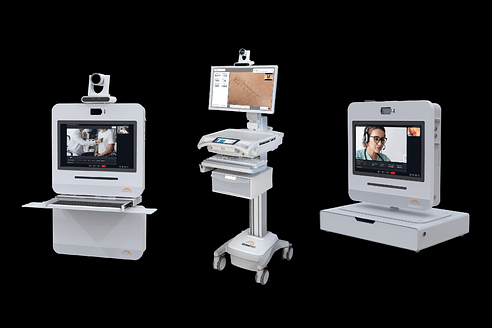
GlobalMed’s eNcounter® platform brings these pieces together through connected clinical devices, 55+ clinical modalities, remote specialist review, and clinical documentation. Built for federal, rural, correctional, and austere care environments, it helps extend virtual care beyond traditional video consultations. With more than 100 million consults delivered in 60+ countries, GlobalMed brings a proven, evidence-based deployment record to the environments where integrated virtual health technology matters most.
To learn more about what GlobalMed can do for your organization