Austere Environment Virtual Health | GlobalMed


Military Virtual Health Solutions
Defense Health Agency Networks
The Department of Defense (DoD) Authorization to Operate establishes that GlobalMed meets rigorous security and operational standards in healthcare. What it enables in practice is specialist care delivered at the point of need, within DoD network infrastructure, without security concessions or workaround architecture.
GlobalMed is actively deployed across Defense Health Agency networks, which serve more than 170,000 healthcare personnel and support nearly 10 million beneficiaries. The eNcounter platform connects point-of-care providers to remote specialists under the same security requirements that govern every other system on those networks. In FY2025, that same platform delivered more than 121,000 virtual audiology episodes to veterans who would otherwise have had to travel long distances to access hearing evaluations.
10 million
beneficiaries supported
170,000
healthcare personnel served
121,000
virtual audiology episodes in 2025
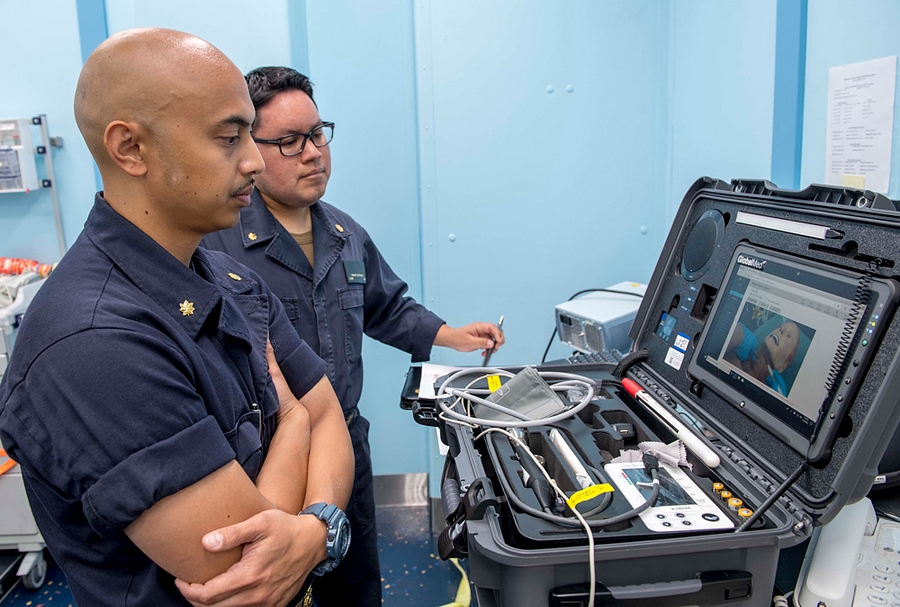
Deployable Equipment Built for the Field
GlobalMed's hardware line was designed around the reality that care often needs to happen well outside any fixed facility.
The Transportable Exam Backpack (TEB) puts a complete virtual examination kit in a single lightweight pack. Equipped with a laptop and integrated diagnostic tools, it deploys hands-free, requires no specialized setup, and connects via universal USB. A medic carrying a TEB can conduct a clinical-quality remote examination from any location with connectivity.
For team-level deployments, the Transportable Exam Station (TES) scales that capability into a ruggedized, pressurized case built for austere environments. Wi-Fi, cellular, and SATCOM connectivity keep it operational when other communications infrastructure is unavailable or degraded.
The Mobile Medical Unit extends coverage to full-team operations on a reinforced vehicle platform with Starlink-compatible satellite communications. Key specs:
- 6-person capacity, deployable in under 15 minutes with a two-person crew
- Transportable by flatbed or helicopter lift
- HEPA air filtration and negative air pressure capability for infectious disease scenarios
- Pathogen-resistant interior surfaces
- Optional software configurations for command and control: live video feeds, drone integration, and AI-based threat detection

Virtual Care for Disaster Response
A disaster zone lacks the infrastructure a virtual health platform typically requires: no stable connection, no power grid, no road access, no clinical facility within reach.
When Cyclone Idai struck Zimbabwe's Manicaland Province in March 2019, GlobalMed's telemedicine network was already operating across 16 clinics in the region. The storm killed more than 1,300 people and triggered a cholera outbreak that reached over 4,000 patients. Those clinics absorbed the surge, connecting patients to doctors immediately while the province's hospitals were overwhelmed.
During a separate emergency training operation in Romania, GlobalMed maintained clinical connectivity more than 100 feet underground.
Where no infrastructure exists at all, GlobalMed's Mobile Medical Unit is built to arrive as the infrastructure: integrating Starlink satellite connectivity, AI-powered clinical decision support, and drone integration in a self-contained unit, requiring nothing external to operate.
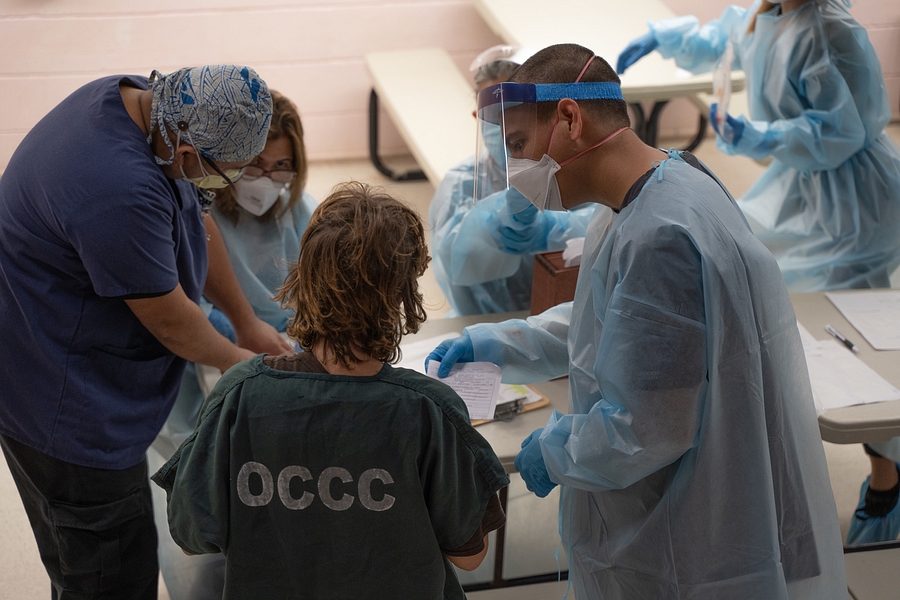
Remote Correctional and Custodial Care
Correctional procurement is not a standard healthcare buying process. Security requirements are layered, compliance documentation needs to be thorough, and any platform that handles patient data inside a controlled environment must meet standards that the general health IT market does not always demand.
GlobalMed's platform meets the compliance and security requirements that correctional procurement teams work through:
- HIPAA and SOC 2
- CAC/PIV reader on the ClinicalAccess® Kiosk, ClinicalAccess Pro Connect, and Transportable Exam Backpack for access-controlled environments
- Encrypted data transmission with role-based permissions and PHI access logging through eNcounter®
- Defense Health Agency Authority to Operate on DoD networks, reflecting federal-grade standards around data access, audit trails, and system integrity
The National Commission on Correctional Health Care (NCCHC) recommends the use of correctional facility telehealth solutions when clinically appropriate, with protocols requiring voluntary informed consent, privacy protections equivalent to in-person care, and continuity of care, a framework that GlobalMed's platform is built to support.