Ultrasound in Austere Environments

When a medic needs to rule out internal bleeding at a forward operating base, or an offshore paramedic needs to assess chest trauma on a platform with no clinic nearby, conventional ultrasound equipment fails before the exam even starts. No stable power. No sterile surface. No trained sonographer on-site. This article covers why standard equipment breaks down in these conditions, what clinicians in military, oil and gas, and disaster response settings actually need from ultrasound in austere environments, and what a field-ready solution actually looks like.
ClearProbe® vs. conventional ultrasound: field readiness at a glance
| Criteria | Conventional Hospital Ultrasound | ClearProbe® |
| Power requirement | Dedicated AC outlet and cart | USB-powered via any laptop |
| Weight and portability | 50 to 300+ lbs | Lightweight, handheld probe |
| Setup environment | Controlled clinical setting | Any environment |
| Sterility requirements | Sterile room and surface required | Field-deployable |
| Connectivity | Proprietary console | Standard USB compatible |
| Transducer types | Single or separately swappable | Two transducer types included |
| Specialties covered | Typically one | Family medicine, OB/GYN, urology, internal medicine |
| Color flow mapping | Standard on consoles | Yes |
| High depth range | Yes | Yes |
| Trained operator required on-site | Yes | No, On-site operator, remote specialist interprets via eNcounter®️ |
| Suitable for offshore, military, disaster | Unlikely; impractical, infrastructure-dependent
| Yes |
| Integration with telemedicine platform | Rarely | Native to GlobalMed ecosystem |
Why standard ultrasound equipment fails in the field
| Conventional Ultrasound Assumes | Austere Environment Provides |
| Stable AC power from a dedicated outlet | Shared generators with no guarantee of availability |
| Climate-controlled, sterile surfaces | Tent floors, ship decks, improvised staging areas |
| Trained sonographer on-site | Medics, paramedics, and emergency responders |
| Proprietary console and cart infrastructure | No fixed infrastructure |
Conventional ultrasound was designed for hospitals, and the conditions hospitals provide are the same conditions that austere environments cannot. The result is equipment that works reliably in a clinic and fails the moment it leaves one.
A 2024 scoping review published in PLoS ONE by researchers at Duke University School of Medicine and the Durham VA Healthcare System reviewed 324 studies and confirmed that point-of-care ultrasound has genuine potential to improve diagnostic accuracy in military combat zones, low-resource desert and tropical environments, microgravity, and high altitude. The same review flagged dissemination in non-hospital settings as an active gap. The imaging capability exists. Standard equipment just does not reach the environments where it is needed most.
What point-of-care ultrasound remote environments require
The U.S. military identified field imaging as a readiness problem in the mid-1990s, when DARPA funded development of a portable ultrasound for military field use. The same gap applies to oil and gas operators managing workers hundreds of miles offshore and to disaster response teams deploying into areas where hospitals are damaged or inaccessible.
Field medicine requires four things from a handheld ultrasound austere settings solution that standard spec sheets don’t always address together. The fourth criterion, telemedicine integration, is where most field-deployed devices fall short.
Research from two separate deployments shows the difference that criteria make when all four are present. A prospective study in the Amazon jungle tested a battery-operated portable ultrasound with two interchangeable transducers on patients with no hospital access. Of 25 scans, results changed the clinical decision for seven patients, and four avoided a dangerous two-day evacuation. A 2021 review in the Journal of Special Operations Medicine documented comparable outcomes at the U.S. Army 21st Combat Support Hospital in northern Iraq, where 401 exams over six months decreased unnecessary evacuation and increased local diagnostic capacity.
A device that generates a good image but cannot route it to a physician who can act on it delivers significantly less field value than its spec sheet suggests, which is why portable ultrasound for military, offshore, and disaster response settings must be evaluated as a platform decision, not a hardware decision.
How ClearProbe® addresses ultrasound in austere environments
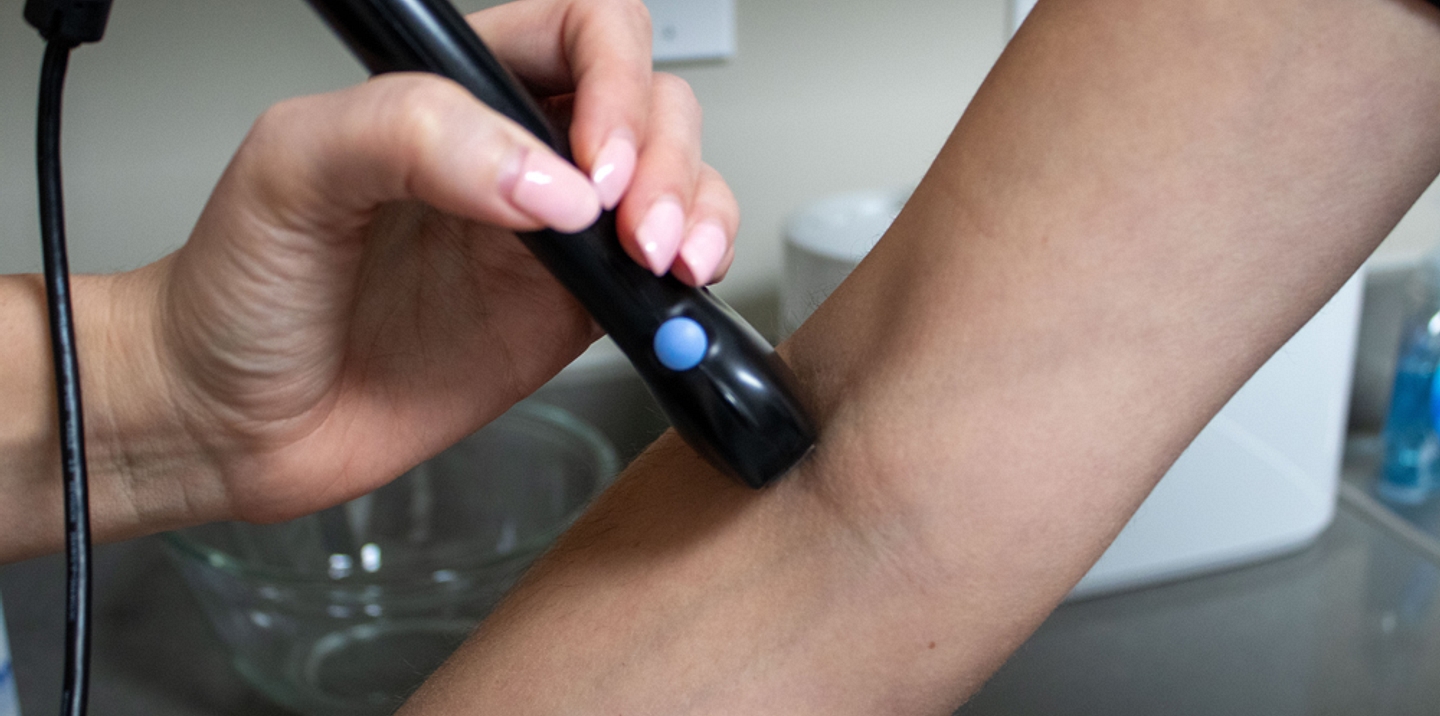
ClearProbe® connects to any laptop via USB and draws power through that connection. There is no AC outlet requirement, no proprietary cart, and no console that needs separate transport. In settings where power is shared and infrastructure is improvised, that design choice determines whether the device actually deploys.
The two transducer types cover family medicine, OB/GYN, urology, and internal medicine from one kit. A medic at a forward operating base can assess abdominal trauma in one patient, then evaluate a cardiac event or obstetric concern in the next, without sourcing different hardware. Color flow mapping and a high depth range deliver the imaging quality that clinical decisions require.
When paired with GlobalMed's eNcounter® platform, ClearProbe® streams images and live video directly to a remote specialist in real time. The clinician on-site conducts the exam. The specialist interprets and directs from anywhere, so the field team is never making diagnostic decisions in isolation. ClearProbe® integrates into GlobalMed's Transportable Exam Backpack, a full mobile clinic in a single pack, and the ruggedized Transportable Exam Station, built for pressurized, dust-proof field deployment.
The field doesn't wait. Neither should your equipment.
ClearProbe® closes the gap between what conventional ultrasound provides and what the field demands. Built to run USB-powered on any laptop, cover multiple specialties from one kit, and connect to a remote specialist through eNcounter®, it is a device designed for the environment rather than adapted to it. Ultrasound in austere environments works when the hardware was engineered for it, and GlobalMed's platform has demonstrated that across approximately 100 million consults in over 60 countries. The next step is seeing how ClearProbe® performs under your specific conditions.