Virtual Nursing and AI: The Next Stage of Hospital Care

Virtual nursing programs are expanding as hospitals use remote registered nurses for patient observation, admission and discharge activities, education, documentation, and care coordination. An AONL-sponsored review of virtual nursing adoption identified 2024 as the first year in which a majority of surveyed U.S. hospitals and health systems were expected to have a virtual nursing program.
As these programs grow, however, virtual nurses must manage more patient information, documentation, alerts, and requests across multiple units. Some health organizations see this as an opportunity to bring in AI to help organize information, prioritize tasks, and prepare documentation while nurses remain responsible for assessment and clinical judgment.
Below, we examine what virtual nursing and AI are delivering today, where AI is already being used or evaluated, how hospitals should measure its value, and what safeguards are needed before expanding it.
Virtual Nursing Today: Adoption, Use Cases, and Measured Results
| Evidence point | Current signal | What it shows |
| Hospital adoption | A 2024 survey of hospital leaders found that 46% were piloting or had implemented virtual nursing for inpatient acute care, up from 38% in the prior survey. | Virtual nursing adoption is growing, although program scope and maturity vary. |
| Most common uses | In a 2025 survey of 880 nurses published in JAMA Network Open, reported uses included patient observation at 53%, admission and discharge at 45%, and patient education at 37%. | Current programs focus on observation, patient flow, and education. |
| Workload impact | In the same survey, 57% of respondents said virtual nursing had not reduced their workload, while 10% said it had increased their workload. | Adoption alone does not guarantee efficiency. |
| Large-scale implementation | The American Hospital Association reports that Hackensack Meridian Health deployed virtual nursing across 18 hospitals and more than 500 care locations. | Virtual nursing can operate across a health system rather than only on one unit. |
| Reported outcomes | Hackensack Meridian Health reported an 11.6% reduction in length of stay, a 0.68% decrease in readmissions, and a two-point reduction in falls with injury after implementation. | Early results are promising, but these are organization-specific findings, not universal benchmarks. |
The evidence points to two conclusions. First, hospitals are using virtual nurses for several different functions rather than following one standard model. Second, outcomes depend on staffing, task design, training, and EHR integration. Virtual nursing should therefore be evaluated as an operating model rather than as a video platform or staffing supplement.
What Virtual Nursing and AI Add to Hospital Care
AI should make virtual nursing more focused and responsive, not remove nurses from the care process. Its potential value falls into five areas, but each has a different level of maturity.
Ambient Documentation and Charting Support
AI-assisted nursing documentation is shifting from speech recognition to structured note generation, but evidence supporting its use in virtual nursing remains limited at this time. In a 2026 nursing study, a voice-to-report system combined automatic speech recognition with a large language model to generate DART notes for nursing documentation. The system achieved a macro-averaged F1 score of 0.82 and a reported hallucination rate of 2.51%, while 75.8% of participating nurses reported a favorable experience. The evaluation covered one system and workflow, so the results should not be treated as a universal benchmark.
In use today: Voice-based systems that generate structured nursing documentation for review and approval.
Still emerging: Ambient capture across virtual nursing workflows, with reliable handling of care plans, patient education, medication information, and escalation details.
Hospitals should measure editing time, omission and hallucination rates, approval rates, nurse satisfaction, and whether the tool reduces documentation work without creating additional review or patient-safety risks.
Predictive Deterioration and Fall-Risk Alerts
Predictive tools analyze patient information and identify patterns associated with deterioration or falls. GlobalMed’s healthcare AI solutions illustrate how passive monitoring and predictive insights can help identify changes that warrant closer review. In a virtual nursing program, these tools could help prioritize which patients require closer review or a call to the bedside team.
The important question is not how many alerts a system generates. It is whether those alerts identify meaningful risk early enough to support a useful response. Leaders should evaluate sensitivity, specificity, positive predictive value, false-alarm rates, and the time between an alert and a nurse’s action.
In use today: Risk scores and alerts that help nurses prioritize patient review.
Still emerging: Models that perform consistently across units, patient populations, and changing documentation practices.
AI-Assisted Remote Observation and Virtual Sitting
Virtual nurses already support patient observation and virtual sitting. AI may assist by identifying movement, bed exits, or other patterns that warrant review, allowing nurses to focus attention where it is most needed.
This use case requires clear oversight. An algorithm may identify a possible event, but a nurse still needs to determine what is happening and whether an intervention is appropriate. Hospitals should track alerts per patient, response time, false alarms, escalations, falls, and missed events.
In use today: Remote observation and communication through virtual nursing teams.
Still emerging: AI-assisted prioritization of observation alerts and movement patterns.
Smarter Workload Routing
Virtual nursing programs may serve several units at once. AI could help route admissions, discharges, education requests, observation events, and escalation calls according to urgency, nurse availability, and patient needs.
The goal is to reduce queue time without turning nursing work into an automated dispatch system. Nurses should be able to change priorities, override assignments, and explain why a task was escalated or deferred.
In use today: Centralized virtual nurse coverage across units or locations.
Still emerging: AI-based routing that accounts for clinical urgency, workload, nurse expertise, and patient communication needs.
Automated Admission, Discharge, and Education Support
Admission and discharge tasks are among the most common virtual nursing functions. AI can help organize information, identify missing steps, create patient-specific education drafts, or flag when a patient may need additional explanation.
The nurse remains responsible for confirming that the patient understands the instructions. Hospitals should measure education completion, teach-back performance, discharge delays, follow-up calls, and readmissions rather than assuming an automated script improved comprehension.
In use today: Virtual nurse-led admission, discharge, and patient education.
Still emerging: AI-generated education that adapts reliably to language, health literacy, diagnosis, and patient questions.
How to Evaluate AI-Enabled Virtual Nursing
Hospitals should establish baseline measurements before introducing AI and compare results by unit, shift, patient population, and use case. A single program-wide average can hide high alert volumes or low adoption in specific units.
| Metric | What to measure | Why it matters |
| Documentation time saved | Minutes per note, encounter, or shift | Shows whether AI reduces administrative work |
| Alert accuracy | Sensitivity, specificity, and positive predictive value | Shows whether alerts identify meaningful risk |
| False-alarm rate | False alerts per patient, shift, or monitored hour | Indicates alarm-fatigue risk |
| Response time | Time from alert or task creation to nurse action | Measures operational responsiveness |
| Virtual nurse coverage | Patients, rooms, or units per virtual nurse | Shows whether staffing gains are sustainable |
| Nurse experience | Workload, satisfaction, trust, and override rates | Shows whether the tool helps or adds friction |
| Patient outcomes | Falls, length of stay, discharge time, readmissions, and escalations | Connects the program to care quality |
| Documentation quality | Omission rate, correction time, and approval rate | Confirms that efficiency does not reduce accuracy |
Leaders should pair these metrics with governance questions such as:
- Who reviews and approves AI-generated notes or recommendations?
- What happens when the system is wrong, unavailable, or uncertain?
- How will the hospital prevent alert fatigue?
- Does the tool fit the existing EHR and virtual nursing workflow?
- What patient information does the system collect, store, and transmit?
- Can nurses override the system and record the reason?
- How will the organization monitor performance after implementation?
- What is the fallback process during downtime?
AI should support nursing judgment, not replace it. If nurses cannot understand how an alert was generated or cannot override it when the clinical situation requires, the technology may create new risks instead of reducing workload.
Build AI Into Existing Care Workflows
In terms of the future of AI in healthcare, AI is most useful when it fits the hospital’s staffing model, EHR, virtual nursing program, and governance process. A documentation tool that requires extensive correction may not save time. An alert system that produces more notifications than nurses can review may increase fatigue. A virtual nursing platform that cannot share information with the rest of the care team may create another silo.
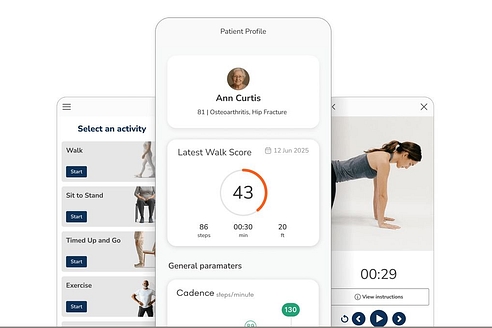
GlobalMed’s eNcounter® telemedicine platform connects local providers with remote specialists through synchronized video and diagnostic data. Where approved for the intended workflow, connected devices can give remote teams access to vital signs, live auscultations, images, and other patient information during the same consultation. GlobalMed also offers AI solutions including tools for virtual triage, ambient sensing, vocal biomarker screening, and gait analysis.
Hospitals should evaluate any AI capability against the intended use case, privacy requirements, EHR workflow, and clinical oversight model rather than assuming that every AI tool is appropriate for virtual nursing. These same considerations shape how hospitals evaluate virtual nursing solutions for hospitals and continuous patient monitoring, particularly when AI must work across staffing models, alert workflows, connected devices, and the EHR.
Keep Nurses in Charge as Virtual Care Becomes More Intelligent
Hospitals evaluating virtual nursing and AI solutions should begin with a defined care problem, baseline metrics, clear nurse oversight, and an integration plan that fits their EHR and existing workflows.
Schedule a Demo to discuss how GlobalMed’s virtual care and AI solutions may fit your program.